Tuesday, 4 September 2012

Why Investors Should Exercise Caution on VALE


Source:  Seeking Alpha
August 30th, 2012

I last wrote on Vale (VALE) in early July this year, and since then, the company's price has fallen further by 22%, and is now trading at around $16 per share. This rapid price decline has seen a number of market pundits emerge, declaring that with a price-to-earnings ratio of around six and a dividend yield of 7%, the company is now a stunning value investment opportunity. In my previous article, I came to the conclusion that Vale was a particularly volatile stock with an unpredictable future because of the significant uncertainty surrounding the company and its operations. This includes the ongoing uncertainty surrounding iron ore prices and the direction of the Chinese economy, along with the growing political risk. At this time, none of these risks have subsided, and in some cases have only magnified, increasing the difficulty in predicting the direction of the stock.

Financial performance continues to be poor
While the company's second quarter 2012 revenue increased in comparison to the first quarter (QoQ) by 7% to $12 billion, net income fell by 30% to $2.7 billion. The company's EBITDA, which I believe is a better measure for comparing financial performance, increased QoQ by 3% to $5.1 billion.

But in comparison to the same period for 2011 (YoY), Vale's second quarter 2012 performance was extremely poor. Reported revenue was down by 21%, EBITDA was down by 44% and net income declined by 58%. It is this considerable downturn in financial performance that has caused the share price to plunge 40% over the last year.

The company's cost-of-goods-sold (COGS) for the second quarter 2012 also increased QoQ by 5.7% to $6 billion as a result of increased production. This gives Vale a COGS to revenue ratio of almost 50%, which is an indicator of efficiency, remains unchanged from the previous quarter. This indicates that, despite increasing production, Vale has been able to continue operating efficiently -- and more efficiently than either Rio Tinto (RIO) or BHP Billiton (BHP), with COGS to revenue ratios for the second quarter 2012 of 67% and 69%, respectively.

These numbers, along with the many positive comments coming from the Vale camp regarding the future of iron ore prices and company performance, leave a particularly positive view of the company. But there are many additional factors that investors need to take into account before taking the plunge and investing in Vale at this time.

Despite attempts to diversify production, iron ore is the key profit driver
The majority of Vale's revenues are derived from iron ore products, which in the second quarter, accounted for 70% of all revenue. This was then followed by nickel, fertilizer nutrients such as potash and phosphates, copper, and then logistics, as the chart below shows.
(click images to enlarge)
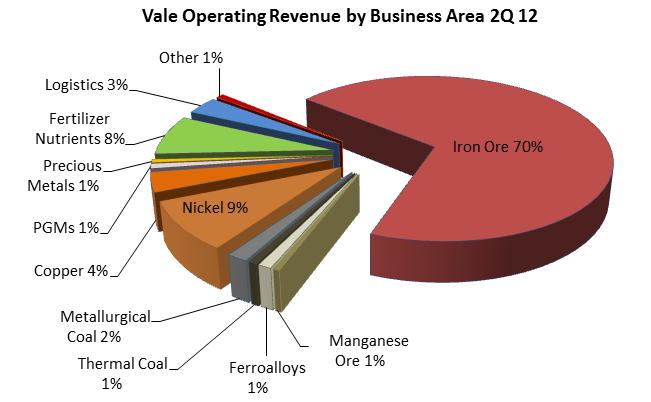
 
Source data: Vale US GAAP 2Q12 Performance


While Vale has sought to diversify its revenues, iron ore is the key driver of profitability. Furthermore, these efforts at diversification have not been particularly successful, with Vale's choices of producing base metals and fertilizer nutrients also seeing their prices fall, along with other commodities because of the current global headwinds.

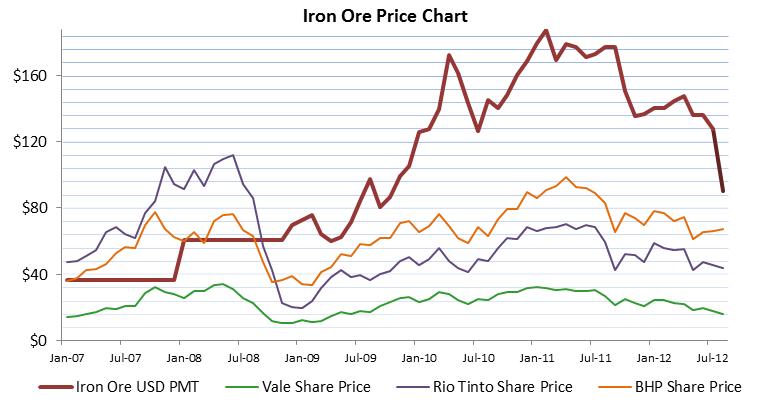
This dependence on iron ore as the key revenue generator means there is obviously a significant correlation between the iron ore price and Vale's share price, as shown in the chart below.
 
Source data: Index Mundi, Bloomberg, Yahoo Finance, Fidelity


However, interestingly, the chart indicates that both BHP's and Rio's share prices have a greater correlation to the price of iron ore than Vale's. This would indicate that there are other factors holding back Vale's share price that are unrelated to iron ore price.

The iron ore price is deteriorating rapidly
Over the last eight months, the price of iron ore has deteriorated rapidly, and is now at $90 per metric ton (pmt). This is the lowest price for iron ore seen since October 2009, and represents a 52% fall from iron ore's peak price of $187.18 pmt in February 2011, as well as a 36% decline for the year-to-date.

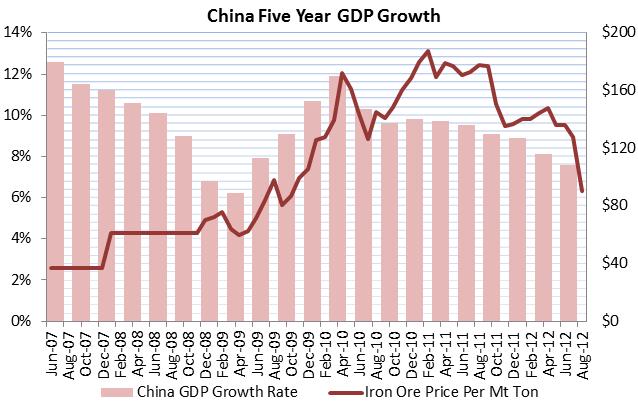
The primary drivers for the plunge in iron ore prices is the government-induced soft landing in China, which has seen Chinese economic activity, and therefore demand, for basic materials slow significantly. For the second quarter 2012, China's economy expanded by 7.6%, which is its slowest rate since the first quarter of 2009. It is also predicted that there won't be a significant uptick in economic activity for the third quarter and that full year economic growth will be around 8.2%.

 
Source data: Index Mundi, Bloomberg, National Bureau of Statistics of China


This chart also illustrates the correlation between the rate of Chinese economic growth and the iron ore price. This correlation, along with that between the iron ore price and Vale's share price, clearly indicates that Chinese economic growth is key to Vale's financial performance and value.

Chinese economic outlook is uncertain
The long-term outlook for China is positive, with the country still in the midst of growing its economy, building infrastructure and industrializing. This process brings with it a tremendous demand for basic materials, ranging from those required to build the industrial infrastructure of a growing manufacturing base to constructing the housing and commercial infrastructure for a rapidly urbanizing population and expanding business sector.

But for the short to medium-term, the outlook is not so bright. This can be attributed to a number of factors, but key are the global headwinds caused by Europe's financial crisis and ensuing austerity measures, which have caused the demand for a wide range of goods manufactured in China to fall. In conjunction with this is the Chinese government-induced soft landing, which has been used to rein in a growing property bubble and spiraling inflation.

The latest Chinese manufacturing and non-manufacturing PMI data was also not particularly positive for investors. For July 2012, the manufacturing PMI came in at 50.1 points, which is its lowest point since November 2011. The non-manufacturing PMI came in at 55.6 points, which was a 1.1 point decrease from June. But on a positive note, both PMIs are still above the all-critical 50 point threshold, which differentiates between whether economic activity is expanding or contracting, with 50% representing now change.

Furthermore, with European headwinds having a greater than expected impact on the Chinese economy, leading it to slow more than planned, it is likely that the Chinese government will consider easing economic policy in an effort to head-off a broader economic slowdown. This will be primarily driven by policies aimed at promoting domestic demand as a means of buoying industrial production. Normally any measures that indicate increased Chinese economic growth would be a strong positive indicator for commodities stocks. This leaves a far more positive impression of the outlook for China, and one would think, the demand for basic materials like iron ore.

Demand for iron ore will remain low for some time
Despite this positive long-term outlook, however, there are two factors that will affect the demand for iron ore and other basic materials in the short to medium-term. The first is that the Chinese government is determined to switch from an export driven economy, particularly in light of the impact of the European crisis on China, to one that is driven by domestic consumption and demand. Obviously, this will cause the demand for basic materials to slow over the long-term, as discretionary consumer industries and financial services grow, and manufacturing for export growth becomes less important.

However, the transition to an economy driven by domestic consumption requires a far higher degree of development, and typically the transition from being upper middle income to a high income economy. China is only starting out on this path and to complete this transition, will require a considerable amount of further development.

The second, and probably the most significant, factor affecting the short-term demand and price for iron ore are the large stock piles if it and other basic materials currently held in China. At the end of June 2012, it was estimated that iron ore stock piles almost totaled 100 million tons, and that other raw materials stock piles were continuing to grow. Until these massive stock piles have been reduced, it would not be profitable for manufacturers to continue importing raw materials at the pace they have been in the past.

The consensus long-term forecast price for iron ore is in the $75 to $80 pmt range, and I certainly believe this is where the price will move given the muted demand and high iron ore inventories in China. This is significantly lower than the average second quarter 2012 iron ore price of $103 pmt Vale received, and the $109 pmt received in the first quarter. For the next two quarters, it is likely that the iron ore price will be moving around the $90 pmt.

Other immediate matters and risks affecting Vale
Vale is also exposed to a considerable amount of political risk, which is leaving the company engulfed in uncertainty, and which is certainly affecting its pricing. These issues are rarely mentioned by the pundits claiming that Vale represents value at its current price, however, they are having a material effect on the company's performance and outlook.

The first issue is a taxation dispute arising from a Brazilian government claim for an additional $15 billion tax on profits from Vale's foreign subsidiaries. Already to date, Vale has contested this claim on the basis that it constitutes double taxation and is, therefore, a breach of the Brazilian constitution. The lower court, which originally heard the matter, found in favor of the Brazilian government and this decision was upheld on appeal to the 2nd Federal Region Tribunal. The matter is now before the Brazilian Federal Supreme Court for deliberation, and a decision has yet to be handed down.

While Vale's CEO Murilo Ferreira is confident of winning the case, the lack of transparency in the Brazilian legal system and the government's willingness to overtly interfere in the economy makes it difficult to determine the outcome with any certainty. It also appears unlikely that the Supreme Court will find in favor of Vale when two lesser courts have made rulings against the company in favor of the government's claim.

If Vale loses the appeal and has to pay the additional taxes, the company's capital expenditure program will effectively be crippled. This will prevent the company from diversifying its revenues outside of iron ore and continuing to invest in a range of projects. These projects include the Belo Monte hydroelectric power plant, the Pacific Hydro wind energy joint venture and the company's expansion into Canadian potash, which has already been postponed.

Vale is also embroiled in a royalties dispute with the Brazilian government. The government is claiming that the company owes an additional $2 billion in royalties. It is likely that this matter will be settled over the next month, and it has been speculated that, as part of the settlement, Vale will pay the full amount claimed by the government.

Both of these matters leave me feeling particularly uneasy about investing in the company in an environment where the price of its principal product, iron ore, is falling precipitously and can't be determined with any degree of certainty.

Valuing Vale
Many of the pundits who are calling Vale a value opportunity are doing so on the basis that it is trading with a TTM P/E ratio of 6 and has a TTM dividend yield of 7%. These ratios in comparison to many other stocks make Vale look like a bargain that is too good to miss. But many of these ratios are based on historical indicators and data, which means they do not take into account the less than optimistic future outlook for iron ore prices.

For this reason, I have attempted to determine a valuation range for Vale using a free cash flow to equity valuation based on the following assumptions:
  • The iron ore price is calculated at $90 pmt, which is a 15% decrease from the average price received by Vale over the first half of 2012.
  • Expenses remain steady, with the COGS to revenue ratio remaining at around 50%.
  • Capital expenditure remains unchanged, but I would expect this to drop if the price of iron continues to move downward.
  • The assumed rate of growth is negative 12% based on the price of iron or for the remainder of 2012.
Based on these assumptions, I arrived at a short-term indicative price of around $16, but there are a wide range of factors and assumptions that can change this. I have allowed for a range of different assumed growth rates in the table below, and set out the corresponding prices per share that were calculated:


It is important to stress that these are indicative prices only. When calculating these valuations, I have only taken into account a limited range of assumptions regarding Vale's operating environment. Investors should recognize that there is a significant range of factors and combinations of these factors that have the potential to negatively impact Vale's share price.

Bottom line
The outlook for Vale over the short-term is particularly uncertain, and at this time, the medium and long-term outlooks are not particularly positive. At current iron ore prices, I would expect to see the company cut its shareholder remuneration, with the first payments to be cut being the interest on shareholders' equity (ISE). It would be impossible for Vale to suspend its dividend payment completely unless it reports a net loss, because Brazilian companies are legally compelled to payout 25% of net profit to shareholders.

Furthermore, it is clear that Vale is still surrounded by significant uncertainty, which makes it impossible to state that it represents a value at its current price, nor is it possible to pick the stock's bottom. This is primarily due to not only the uncertainty surrounding the iron ore price, but also the financial risk associated with the tax and royalties disputes, which total $17 billion.

For these reasons, I am very hesitant to make any positive statements regarding the outlook for Vale, particularly with so many unknowns that have a high potential financial impact on the company yet to be played out. In the wrong set of circumstances, including a significant dividend cut, it is feasible that Vale's share price will move well below its current price. For all of these reasons, it would be prudent for investors to take a wait and see approach, while monitoring the leading indicators of Chinese economic activity and iron ore demand, as well as the outcomes of the tax and royalty disputes.

Friday, 22 June 2012

An Earth Summit Draws on Oil, Mining and Utility Largess

June 21, 2012, 2:02 pm

An Earth Summit Draws on Oil, Mining and Utility Largess


RIO DE JANEIRO - The cups at the water coolers here at Rio+20, the global sustainability conference taking place Wednesday through Friday, are made of rough biodegradable corn fiber rather than plastic. Vans running on second-generation ethanol made from sugar cane bagasse take conference members, free of charge, from the hotels on the Copacabana beach to the conference center an hour away.

There, speedy Wi-Fi is offered to tens of thousands of participants so they can avoid printing out Rio+20 documents, and biodiesel generators power the million square feet of conference grounds.
Some of this is financed by millions of dollars in financial support from Brazil's largest energy, extraction and petroleum corporations. Those include businesses like the mining giant Vale, voted the "worst company of the year" in the 2012 Public Eye Awards, and Eletrobras, the state electricity company, a partner with Vale in developing the Belo Monte dam project on the Xingu River.

Environmental activists oppose the project, saying that it will drive out thousands of indigenous and other people by drying up the river and causing them to lose their livelihoods. The government has emphasized that no indigenous people will be forcibly removed from their land by the project.

The Inter-American Commission on Human Rights, part of the Organization of American States, asked Brazil last year to suspend dam construction until an agreement was reached with the indigenous communities; the government declined.

Belo Monte is the largest among dozens of controversial dam projects planned in Brazil's Amazon region. Although various environmental groups have protested the Belo Monte project on the sidelines of Rio+20, relatively few seem to making a big point of the conference's corporate sponsorship.

Of the quarter-billion dollars or so that Brazil plans to spend on the conference, most -- some $210 million -- comes from a special government fund, according to official documents cited by the Brazilian newspaper Valor Econômico. About $10 million was contributed by each of the official Rio+20 partners, corporations including Vale, Eletrobras and Petrobras, the state oil company. The conference expenses primarily involve installations, logistics, transportation, accommodations and security. Some 20,000 soldiers, police officers, municipal guards and intelligence service agents have been deployed on Rio's streets for the event.

Friday, 4:56 p.m. | Updated Asked about its choice to accept corporate sponsorship from energy and mining companies, the Brazilian Foreign Ministry said in a statement that it has specifically sought to include corporations to "bring these industries closer to environmental-friendly standards." All companies that presented themselves as "willing partners" of Rio+20 were accepted, it added.
Eletrobras, which has a 49.98 percent stake in the Belo Monte dam, said in a statement that its sponsorship role was "appropriate" because of its investment in hydroelectric power, a clean energy source. It said that Brazil needed to increase its capacity by 5,000 to 6,000 megawatts a year to meet the demands of the nation's population of nearly 200 million, and that roughly 80 percent of potential hydroelectric production is in the Amazon region.

Vale, which is investing $1.5 billion in the dam and has a 9 percent stake in the project, said it was acting as a Rio+20 sponsor so that the conference would have "a larger dimension and visibility for society over all, given the themes that are being discussed, which are of great interest to the business."

Petrobras, which routinely finances cultural events and nongovernmental organizations in Brazil, is now aggressively developing (along with foreign oil companies) deepwater "pre-salt" oil reserves about 200 miles off Brazil's shores. The government has promoted the pre-salt find as a kind of national bounty set to catapult Brazil to the level of Arab oil-producing nations and elevate Venezuela's status as an oil exporter.

But environmental groups like Greenpeace have complained that consumption of oil from the pre-salt fields could add 35 billion tons of carbon dioxide to the atmosphere over the next 40 years. Petrobras's heavy investment in extracting the deepwater oil will assure that Brazil is petroleum-dependent for decades to come, the group adds.

The company emphasizes that it has been ranked on the Dow Jones Sustainability Index for six years and is a signatory of the United Nations Global Compact, which commits businesses to aligning their operations with high principles on the environment, human rights and other causes.

Such corporate participation in Rio+20 does not sit well with Danilo Chammas, a lawyer with Justiça nos Trilhos (Justice on the Trails), the group that nominated Vale for the Public Eye Award. The group took part in a 2,000-strong protest on Tuesday in front of the company's headquarters in Rio.
"It's a shame," he said, adding: "Many people should be questioning this."

Sunday, 17 June 2012

VALE - Mining giant investigated over alleged Brazil environmental breaches

31/05/2012

Source: Greenwood Management ApS

One of the world’s largest mining firms is under investigation over claims that it contravened environmental laws put in place to protect Brazilian forests and native tribal land.

Brazil’s prosecutors office is looking into reports that Vale SA failed to replant destroyed forest land and improperly used Amazon Indian land when operating two huge copper mines in the Amazon region. The forest were reportedly damaged when the mining giant built a power line for the one of the mines.

The Sossego copper mine, which is the firm’s most productive copper mine – producing 109,000 tonnes last year – is being investigated over the claims that Vale improperly used Indian land. However, Vale emailed Reuters to defend its case, claiming that both of its copper mines were at least 50km away from the Indian settlements of Cateté and Djudjêkô and that they are both located outside the Xikrin reservation. Vale also added that it was not aware of the details of the investigation that is underway.

The power line investigation centres around claims that, in building a power line for the Salobo copper mine, Vale failed to replant damaged parts of the forest. The firm told Reuters that it had permission to suppress vegetation from the regulator that had legal powers in the region. Vale is currently expanding the production capacity at the Salobo mine, from 100,000 tonnes of copper concentrate per year, to 200,000.

The firm is also under investigation over its alleged failure to meet obligation to two tribes affected by its Onça Puma nickel mine, which is also located in the Amazon region. Vale produced more iron ore than any other mining firm in the world and is seen as a vital producer of raw materials for the steel industry.

The steel industry in Brazil is booming at the moment, thanks to its economic growth and resulting investment in infrastructure. The fact that the country is hosting both the FIFA World Cup and the Olympics within the coming four years is also boosting the steel industry.

The steel industry has, in recent years, been encouraged to use charcoal from renewable plantations – such as those run by Greenwood Management – during the production of steel. The use of native timber in the production of charcoal was discouraged by stopping steel firms from receiving government cash if they used charcoal from the native forests. As a result, the demand for sustainably produced charcoal has increased.

With regards to the progress of the investigation into Vale’s alleged environmental breaches, no charges have yet been made. Vale, meanwhile, claims it is waiting for formal notification of the investigation and is willing to cooperate by providing any information needed.


Thursday, 26 April 2012

VALE FERTILIZERS FIRES WORKERS, including a HEALTH AND SAFETY COMMITTEE MEMBER, and a worker ON MEDICAL LEAVE


Source: Sindiquimica-PR
 
After the collective bargaining agreement was signed - in which workers' resistance prevented the removal of historical clauses - the company director, as a way of  retaliating against workers who had demonstrated in meetings or at the factory gate during the negotiations, harasses them, and fires them.

Thus, even with a reduced number of operators coerced by management to, work up to 16 hours (confirmed by assessments of the supervisor's work SRTE-PR), Vale Fertilizers, in an attack on union representation, fired 4 workers, 1  on medical leave, 1 health and safety committee member indicated by the company and others with 25 years of experience. Since the beginning of negotiations (nov/2011), 12 have been fired, 6 have received warnings and 16 have been harassed.  Of these, 5 have already been dismissed. It’s the largest number of layoffs since the company was privatized in 1993.

The humiliation and torture at the time of dismissal were such that in one case it even caused an accident with the employee to be fired, - and he had medical restrictions. This employee, after treatment at the hospital and with medical certification, was forced to return to the factory by officials who accompanied him and was only released after signing his letter of resignation.

The union rejects what is happening and asks all unions and NGOs to denounce what is happening at the Vale unit in Araucaria Parana, with a copy to the chair of Vale Fertilizers:

eduardo.bartolomeo @ vale.com;
Djalma. barbosa@vale.com

and the Vale executives:

maria.gurgel @ vale.com;
murilo.ferreira @ vale.com;
vânia.somavilla @ vale.com

 
For further information:
 
Sindiquimica-PR 

Phone: +55 41 3327 3458 
www.sindiquimicapr.com.br
sindiquimica.pr@gmail.com

Saturday, 21 April 2012

Protestors Target Mining Giant Vale in Brazil


Press Release

Activists attend Rio shareholder meeting, call out company's severe labor, human rights and environmental violations

Rio de Janeiro, Brazil – On Wednesday over 150 demonstrators from communities and workers affected by the operations of Brazilian multinational giant Vale staged a protest at its corporate headquarters in downtown Rio de Janeiro, coinciding with an annual shareholders meeting. Using megaphones to denounce the social and environmental consequences of Vale's mining and hydropower projects from the Brazilian Amazon to Canada, protesters laid out a trail of red paint along the sidewalk at the building's entrance, symbolizing over 100 victims of accidents along Vale's Carajás Railway in Northern Brazil and other fatalities related to the company's notoriously unsafe working conditions.
Following protests and the shareholder meeting, social movements and NGOs linked to the International Network of People Affected by Vale launched an alternative 2011 "Unsustainability Report" at a press conference, presented as a "shadow document" to the company's official sustainability report.

Vale has grown to become one of the most powerful players in the global mining industry and has come under increasing scrutiny from an international network of human rights, labor and environmental activists. Last January, Vale won the Public Eye Award, known as the "Nobel Prize of Shame" in the corporate world, for the company's record of environmental destruction, social impacts, and labor violations, surpassing contenders such as Tepco, responsible for the nuclear disaster in Fukushima.

While a street demonstration ensued outside Vale's headquarters, six directors of civil society groups participated in the annual shareholders meeting, drawing attention to the gap between corporate discourse on social and environmental responsibility and violations of labor regulations, human rights and environmental legislation. Andressa Caldas, director of the NGO Global Justice, criticized the expropriation and compulsory displacement of over 1,300 families in Moatize, Mozambique as a result of Vale's mammoth Moma mining project, contrasting the company's actions to its discourse regarding so-called "promotion of community development."

Brent Millikan of International Rivers called for the immediate divestment of Vale's 9% stake in Norte Energia, the consortium responsible for the highly controversial Belo Monte hydroelectric dam in the Brazilian Amazon, due to the enormous economic, legal and reputational risks involved.

Danilo Chammas, a lawyer from Justiça nos Trilhos, a network of communities affected by Vale's Carajás mines in northern Brazil, called attention to the rising number of deaths and serious injuries related to mining and railroad operations in the region. Gerson Castellano, director of the Petrochemical Workers' Association in Paraná state, presented data on the growing number of work-related accidents and conflicts with unions and employee representatives. Also present at the shareholders meeting, Carolina Campos of the NGO 4 Cantos called on Vale to abandon plans to develop a huge mining project in Minas Gerais state, in one of the last pristine areas of Brazil's Atlantic Forest, Serra Gandarela, where a proposal to create a national park is under consideration by the federal government.

According to NGO participants in the shareholder meeting, there were signs that Vale is willing to establish a dialogue on social and environmental responsibility. However, many questions remained unanswered, such as the criteria used by Vale to justify its decision to purchase a major stake in Belo Monte. According to Caldas, the lack of robust analysis of social and environmental risk has led in involvement in boondoggles such as the TKCSA mining project in Rio de Janeiro. In answer to questions about the project, Vale General Counsel Clovis Torres stated that Vale disagrees with the policies of TKSCA, have has no power over management, since it is a minority shareholder. When asked why Vale didn't simply divest, Torres claimed "nobody wants to buy our shares."

While maintaining the same basic structure as the Vale's official sustainability official report, that follows the guidelines of the Global Reporting Initiative of the UN Global Compact, the "Unsustainability Report" presents facts and figures regarding such issues as labor relations, occupational health, communities, emissions and waste management. Regarding environmental issues, the report highlights a significant increase in deforestation related to Vale's operations in the Amazon, as well as an increase in greenhouse gas emissions of 70% between 2007 and 2010; during the same period, 76 million tons of liquid effluents and 446,000 tons of solid waste were generated.

In relation to worker and public safety in Vale's mining operations, the report notes 11 deaths and 124 serious accidents along the Carajás Railroad. The report also argues that reductions in investments in worker safety were directly related to accidents that killed two Canadian workers last year at Vale's Sudbury mine.