Thursday, 18 October 2012

COMUNICADO - Naciones Unidas: ¿Quién quiere pasar por la puerta giratoria?

Las políticas del extractivismo salvaje que están depredando aceleradamente la vida, los ecosistemas y las culturas, han penetrado hace ya un tiempo en los organismos internacionales que tienen a su cargo la salvaguarda de derechos.

Códigos de carácter voluntario como el "Pacto Global" o los "Principios Ruggie", relativizan la normativa mundial en beneficio de las inversiones y en desmedro de los derechos conquistados para la defensa y sustentabilidad de la vida. Este tipo de iniciativas son promovidas por personas que se mueven entre el sector privado transnacional y el sector público a nivel nacional o internacional, para defender los intereses corporativos y modificar a su favor la naturaleza de la institucionalidad mundial.
La corrupción de la "puerta giratoria" debe ser denunciada. Ese es el motivo de la declaración adjunta, suscrita por más de 150 organizaciones y comunidades de América Latina, de Europa y de Canadá.
Invitamos a todos/as los interesados/as de todos los países a que apoyen y firmen esta declaración y sus peticiones. Envíe un correo con el nombre de la organización (o nombre individual) y país a la siguiente dirección: finpuertagiratoria@gmail.com


COMUNICADO PUBLICO
Naciones Unidas: ¿Quién quiere pasar por la puerta giratoria?

Organizaciones latinoamericanas y comunidades campesinas, indígenas y afrodescendientes, que vivimos cada día la contaminación y la explotación de nuestros territorios por parte de megaproyectos en mano de empresas nacionales y transnacionales observamos que Naciones Unidas pretende encubrir y normalizar conductas violatorias empresariales que atentan contra los derechos humanos de los pueblos.

Ese órgano fomenta la adopción y promoción de mecanismos voluntarios con respecto al cumplimiento de derechos inalienables de la humanidad, en vez de impulsar un marco regulatorio real y obligatorio. Al mismo tiempo, promueve la contratación de reconocidos portavoces de empresas transnacionales extractivistas para cargos de decisión política en la ONU; y sus expertos salen de cargos relacionados con empresas y derechos humanos para asesorar a corporaciones transnacionales sobre los mecanismos voluntarios.

Las empresas transnacionales ostentan poder económico y político, en muchas ocasiones superiores a los países en donde desarrollan sus actividades, lo que las convierte en actores con enorme capacidad de imponer sus intereses por encima de los derechos de las personas y de los pueblos que viven bajo la esfera de su influencia. Dejarlas al margen de las regulaciones sobre derechos humanos, socava la legitimidad de las estructuras que se pretendan democráticas.

Por ello, las empresas deben ser sancionadas por su participación en violaciones a los derechos humanos, y no gozar de la aplicación de estándares voluntarios, impulsados por ellas mismas, como el Pacto Global de la ONU o Principios Rectores elaborados por John Ruggie.[1] Ese marco desregulatorio, sostiene explícitamente que de los principios expuestos “no se deriva ninguna nueva obligación jurídica”. Entre tanto, las corporaciones transnacionales encuentran o promocionan legislaciones nacionales favorables que se ajusten a sus intereses y la “lex mercatoria”[2] mientras las comunidades se enfrentan con la imposibilidad de acceder a la justicia y de recibir garantías mínimas de protección.

Las puertas giratorias
Luego de hacer el informe que lleva su nombre, John Ruggie dejó su cargo de Representante Especial del Secretario General para los Derechos Humanos y las Empresas, para desempeñarse como Consultor Especial de la empresa minera canadiense Barrick Gold Coporation.[3] Esta empresa está cuestionada por su implicación en múltiples crímenes frente a los derechos de las comunidades afectadas por la explotación minera en Perú, República Dominicana, Argentina y Chile; casos que se encuentran denunciados ante cortes nacionales e internacionales.

Por otro lado, Alexandra Guáqueta, asesora de la empresa Cerrejón y representante de ésta ante el Comité Minero Energético del Programa Presidencial de DDHH y DIH del gobierno colombiano, que reúne a empresas y Fuerza Pública, así como funcionaria de la Oxy Petroleum en Colombia,[4] se ha convertido en la representante de América Latina del exclusivo Grupo de Trabajo de la ONU sobre Empresas Transnacionales y Derechos Humanos.[5] Tanto la empresa Cerrejón como la Oxy Petroleum están acusadas a nivel nacional e internacional por su responsabilidad en graves violaciones a los derechos humanos en Colombia.

Estos dos ejemplos y muchos otros, evidencian el patrón de la puerta giratoria que se viene aplicando en función de la materialización de claros intereses del sector privado. Las "asesorías", que se ocupan de los efectos más chocantes para la opinión pública de las actividades de las empresas, no se ocupan de las causas y permiten a las sociedades transnacionales corregir sus estrategias de imagen (greenwash).[6]
Asimismo, el tránsito permanente de funcionarios estatales y organismos multilaterales a grandes empresas privadas, y viceversa, estimula serias conductas de corrupción, considerando que personas del sector público cuentan con toda clase de información sensible y que ésta se puede poner al servicio de los intereses del sector corporativo.

Ante esta situación insostenible solicitamos al órgano de las Naciones Unidas:

§  Que se abstenga de todo nombramiento de este tipo de personas para cargos relacionados con temas de empresas y derechos humanos.
§  Qué se hagan ampliamente públicos los CV de las personas postuladas para tales cargos.
§  Que se genere un mecanismo interno de control con la finalidad de evitar la injerencia por parte de personas que representan intereses de empresas trasnacionales en temas de derechos humanos.
§  Que haya anualmente una rendición de cuentas por parte de Naciones Unidas con respecto a la puerta giratoria.
§  Que se reconozca en Naciones Unidas el vacío existente sobre la regulación de carácter vinculante hacia las empresas y la necesidad urgente de avanzar hacia ello.

AMÉRICA, 17 DE OCTUBRE DE 2012

FIRMAN:

América Latina
  • 5 Soles Valparaíso Chile
  • ACA, Agrupación de Consumidores de Agua, Río Mostazal Chile
  • Acción Ecológica – Ecuador
  • Acción por el desarrollo y progreso de Caldera Chile
  • ADEF, Amigos de la Flora y Fauna, Vicuña Chile
  • AGE AconcaguaChile
  • Agrupación de Defensa del Valle de ChalingaChile
  • Agrupación de Derechos Humanos, "José Calderón Miranda", Paine – Chile
  • Agrupación Ecológica CHADENATUR, Chañaral – Chile
  • Agrupación Ecológica Cultural del Río MostazalChile
  • Agrupación para el Control del Medio Ambiente y Desarrollo Social de la Comuna de Andacollo (CMA)Chile
  • Agrupación Sociocultural de AtacamaChile
  • Aire Puro ValparaísoChile
  • Amerindia – Chile
  • Amigos da Terra – Brasil
  • APROMAC – Associação de Proteção ao Meio Ambiente de Cianorte Brasil
  • Asamblea Ambiental El MelónChile
  • Asociación de Ciudadanos para la Defensa de la Salud y el Medio Ambiente, Viña del MarChile
  • ATTAC – Argentina
  • Brigada S.O.S. HuascoChile
  • Cátedra de la Paz, Universidad de Los Andes Mérida – Venezuela
  • CENSAT Agua Viva, Amigos de la Tierra – Colombia
  • Centro de Conservación Cetácea – Chile
  • Centro de Documentación e Información CEDIB – Bolivia
  • Centro de Estudiantes de la Comunidad Teológica Evangélica – Chile
  • Centro de Estudios por el Desarrollo Humano Sustentable (CEDEHS)Chile
  • Centro de Mujeres "AMELIA BRUHN, Quilpué – Chile
  • Centro Ecoceanos – Chile
  • CESTA – El Salvador
  • Chile Sustentable - Chile
  • Ciudadanos a la Vanguardia, AntofagastaChile
  • COECOCEIBA, Amigos de la Tierra – Costa Rica
  • Colectivo de Abogados “José Alvear Restrepo”, CCAJAR – Colombia
  • Colectivo de Coordinación de Acciones Socio Ambientales, Colectivo CASA – Bolivia
  • Colectivo Editorial Mapuexpress – Chile
  • Colectivo VientoSur – Chile
  • Colegio de Enfermeras Regional CopiapóChile
  • Comisión del Medio Ambiente del Río CochiguazChile
  • Comisión Ecuménica de DDHH – Ecuador
  • Comisión Ética contra la Tortura – V RegiónChile
  • Comisión Medio Ambiente, Universidad De AtacamaChile
  • Comité de Defensa del Mar, Mehuín – Chile
  • Comité de Defensa del Valle de ChuchiñiChile
  • Comité de Defensa Personal de CaimanesChile
  • Comité de Defensa y Recuperación del Cobre – Chile
  • Comité Esperanza de VidaChile
  • Comité Pro Agua Alto de la Chimba (Ovalle)Chile
  • Comunidad Agrícola TotoralChile
  • Comunidad Colla El Torín Chile
  • Comunidad Ecuménica Martin Luther King – Chile
  • Comunidad Indígena Ancestral Sucesión Blanco, del Territorio “Lago Chungara” Chile
  • Comunidad Indígena Diaguita Sierra de HuachacánChile
  • Consejo de Defensa del Valle del HuascoChile
  • Consejo de Pueblos Originarios, CalamaChile
  • GILANIA, Investigaciones y Desarrollo Experimental en el Desarrollo de las Ciencias Sociales – Chile
  • CooperAcción – Perú
  • Coordinador del Comité de Iniciativa para una Asamblea Constituyente – Chile
  • Coordinadora Ambiental Valles en MovimientoChile
  • Coordinadora de Defensa de la Madre Tierra CODEMAT, IquiqueChile
  • Coquimbo Parte AltaChile
  • Corporación Ecológica EcoQuilpuéChile
  • Corporación la Caleta – Chile
  • Cristianos Nicaragüenses por los Pobres – Nicaragua
  • Departamento JPIC del Obispado de Copiapó – Chile
  • Ecodifusores CoquimboChile
  • Ecosistemas – Chile
  • Editorial Quimantu – Chile
  • Elqui SustentableChile
  • Escuela de Educación Ambiental Chico Mendes, Rosario – Argentina
  • FASE, Brasil
  • Frente Cívico por la Vida de San Juan – Argentina
  • Fuerza Verde CoquimboChile
  • Fundación ECOSUR – Argentina
  • Fundación Ecuménica para el Desarrollo y la Paz – FEDEPAZ – Perú
  • GRUFIDES – Perú 
  • Grupo de Trabajo por Derechos Colectivos – Chile
  • Grupo Ecológico Atacama Limpio – GEALChile
  • Instituto de Ciencias Alejandro Lipschutz, ICAL – Chile
  • Justiça Global, Rio de Janeiro – Brasil
  • JJVV Bahía InglesaChile
  • Lof Filú Ambiente y Territorio, Los VilosChile
  • Manque–Pillán, IllapelChile
  • Marcha Mundial de las Mujeres – Chile
  • Mesa Social contra la Termoeléctrica CastillaChile
  • Mesa Social de AtacamaChile
  • Mesa Trabajo Junta Vecinos TotoralChile
  • Movimento pelas Serras e Águas de Minas, MovSAM – Brasil
  • Movimiento Madre Tierra – Honduras
  • Movimiento Madre Tierra, Arica – Chile
  • Movimiento por la Defensa del Medio Ambiente MODEMA, La HigueraChile
  • Observatorio Latinoamericano de Conflictos Ambientales, OLCA – Chile
  • Oficina de Justicia, Paz e Integridad de la Creación, Sociedad Misionera de San Columbano – Chile
  • ONG Bidas, AntofagastaChile
  • ONG ChileCobre – Chile
  • Organização de Desenvolvimento Sustentável e Comunitário ODESC - Brasil
  • Organización Ciudadana Ambiental Salamanca, OCAS – Chile
  • Organización de Ciudadanos para la Defensa de la Salud y el Medio Ambiente, CoquimboChile
  • Pastoral Salvaguarda de la CreaciónChile
  • Programa Radial Semillas de Agua – Chile
  • Radio del Mar – Chile
  • Red por la Defensa de la Precordillera – Chile
  • Red Ambiental CopayapuChile
  • Red Ambiental LimaríChile
  • Red Ambiental Norte RAN – Chile
  • Red Ambiental Serena–CoquimboChile
  • Red de Acción por los Derechos Ambientales (RADA) Temuko – Chile
  • Red de Mujeres El Loa – Chile
  • Red Ecológica de Chile
  • Red Muqui – Perú
  • Red por la Defensa del Medio Ambiente Arica y Parinacota Chile
  • Rede Justiça nos Trilhos – Brasil
  • Revolución de la Cuchara ValparaísoChile
  • Salvemos los VallesChile
  • SaskimarkaChile
  • Savia, Escuela de Pensamiento Ecologista – Guatemala
  • Surire ComunidadChile
  • TOXISPHERA – Associação de Saúde Ambiental – Brasil
  • Uma Auquina – Chile
  • Unión Comunal de JJVV de IllapelChile

Europa y Canadá
  • Coalición QUISETAL, Québec – Canada
  • Comité Oscar Romero de Vigo – España
  • Ecologistas en Acción – España
  • Grupo SOLIDAIR MET GUATEMALA – Bélgica

Redes y/o plataformas internacionales
  • Amigos de la Tierra América Latina y Caribe – ATALC
  • Comité para la Anulación de la Deuda del Tercer Mundo, CADTM – AYNA
  • Movimiento Mundial por los Bosques Tropicales – WRM
  • Observatorio de Conflictos Mineros de América Latina – OCMAL
  • Plataforma Interamericana de Derechos Humanos, Democracia y Desarrollo (PIDHDD)
  • Red Contra el Monocultivo de Arboles – RECOMA
  • Red Europea De Comités “Oscar Romero”
  • Rede Internacional dos Atingidos pela Vale (International Network of People Affected by Vale)


CC:
  • Señora Laura Dupuy, Representante permanente de Uruguay ante la Oficina de las Naciones Unidas en Ginebra y Presidenta de Consejo de Derechos Humanos, Ginebra
Ban Ki-moon, Secretario General de las Naciones Unidas


[1] En junio de 2011, el Consejo de Derechos Humanos de Naciones Unidas aprobó el informe escrito por John Ruggie, los Principios Rectores sobre las empresas y los derechos humanos para “proteger, respetar y remediar”.
[2] Apartes tomados del documento Alejando Teitelbaum, Comentarios al Informe del Secretario General de la ONU, 2012.
[6] Greenwash: “Disinformation disseminated by an organisation so as to present an environmentally responsible public image” (The Concise Oxford English Dictionnary), 1999.

Tuesday, 4 September 2012

Why Investors Should Exercise Caution on VALE


Source:  Seeking Alpha
August 30th, 2012

I last wrote on Vale (VALE) in early July this year, and since then, the company's price has fallen further by 22%, and is now trading at around $16 per share. This rapid price decline has seen a number of market pundits emerge, declaring that with a price-to-earnings ratio of around six and a dividend yield of 7%, the company is now a stunning value investment opportunity. In my previous article, I came to the conclusion that Vale was a particularly volatile stock with an unpredictable future because of the significant uncertainty surrounding the company and its operations. This includes the ongoing uncertainty surrounding iron ore prices and the direction of the Chinese economy, along with the growing political risk. At this time, none of these risks have subsided, and in some cases have only magnified, increasing the difficulty in predicting the direction of the stock.

Financial performance continues to be poor
While the company's second quarter 2012 revenue increased in comparison to the first quarter (QoQ) by 7% to $12 billion, net income fell by 30% to $2.7 billion. The company's EBITDA, which I believe is a better measure for comparing financial performance, increased QoQ by 3% to $5.1 billion.

But in comparison to the same period for 2011 (YoY), Vale's second quarter 2012 performance was extremely poor. Reported revenue was down by 21%, EBITDA was down by 44% and net income declined by 58%. It is this considerable downturn in financial performance that has caused the share price to plunge 40% over the last year.

The company's cost-of-goods-sold (COGS) for the second quarter 2012 also increased QoQ by 5.7% to $6 billion as a result of increased production. This gives Vale a COGS to revenue ratio of almost 50%, which is an indicator of efficiency, remains unchanged from the previous quarter. This indicates that, despite increasing production, Vale has been able to continue operating efficiently -- and more efficiently than either Rio Tinto (RIO) or BHP Billiton (BHP), with COGS to revenue ratios for the second quarter 2012 of 67% and 69%, respectively.

These numbers, along with the many positive comments coming from the Vale camp regarding the future of iron ore prices and company performance, leave a particularly positive view of the company. But there are many additional factors that investors need to take into account before taking the plunge and investing in Vale at this time.

Despite attempts to diversify production, iron ore is the key profit driver
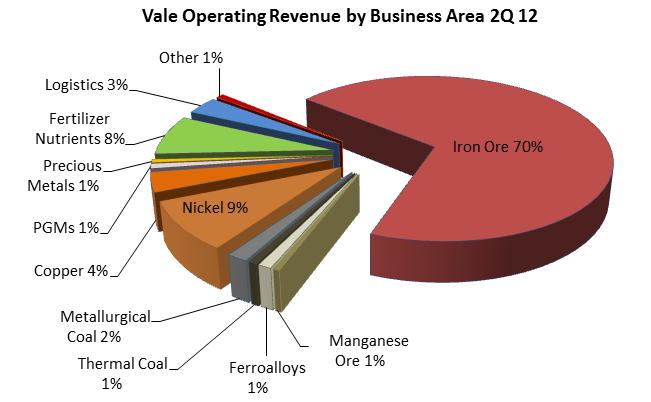
The majority of Vale's revenues are derived from iron ore products, which in the second quarter, accounted for 70% of all revenue. This was then followed by nickel, fertilizer nutrients such as potash and phosphates, copper, and then logistics, as the chart below shows.
(click images to enlarge)

 
Source data: Vale US GAAP 2Q12 Performance


While Vale has sought to diversify its revenues, iron ore is the key driver of profitability. Furthermore, these efforts at diversification have not been particularly successful, with Vale's choices of producing base metals and fertilizer nutrients also seeing their prices fall, along with other commodities because of the current global headwinds.

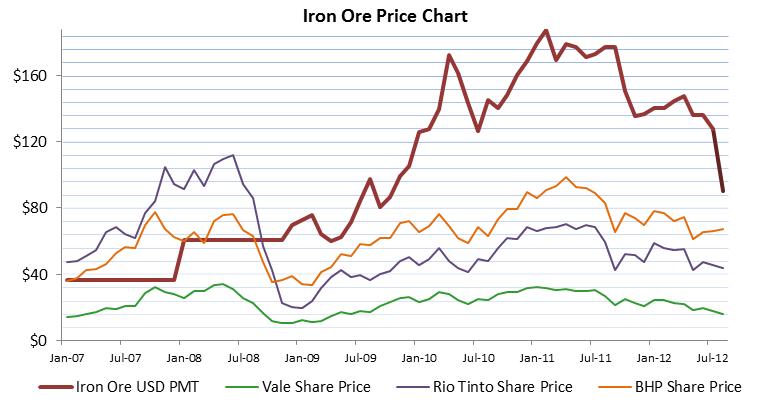
This dependence on iron ore as the key revenue generator means there is obviously a significant correlation between the iron ore price and Vale's share price, as shown in the chart below.

 
Source data: Index Mundi, Bloomberg, Yahoo Finance, Fidelity


However, interestingly, the chart indicates that both BHP's and Rio's share prices have a greater correlation to the price of iron ore than Vale's. This would indicate that there are other factors holding back Vale's share price that are unrelated to iron ore price.

The iron ore price is deteriorating rapidly
Over the last eight months, the price of iron ore has deteriorated rapidly, and is now at $90 per metric ton (pmt). This is the lowest price for iron ore seen since October 2009, and represents a 52% fall from iron ore's peak price of $187.18 pmt in February 2011, as well as a 36% decline for the year-to-date.

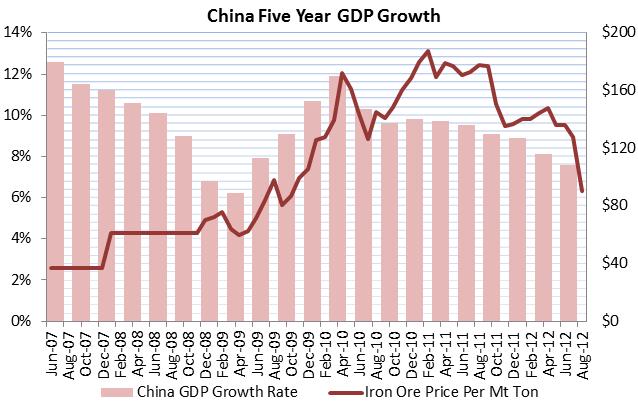
The primary drivers for the plunge in iron ore prices is the government-induced soft landing in China, which has seen Chinese economic activity, and therefore demand, for basic materials slow significantly. For the second quarter 2012, China's economy expanded by 7.6%, which is its slowest rate since the first quarter of 2009. It is also predicted that there won't be a significant uptick in economic activity for the third quarter and that full year economic growth will be around 8.2%.


Source data: Index Mundi, Bloomberg, National Bureau of Statistics of China


This chart also illustrates the correlation between the rate of Chinese economic growth and the iron ore price. This correlation, along with that between the iron ore price and Vale's share price, clearly indicates that Chinese economic growth is key to Vale's financial performance and value.

Chinese economic outlook is uncertain
The long-term outlook for China is positive, with the country still in the midst of growing its economy, building infrastructure and industrializing. This process brings with it a tremendous demand for basic materials, ranging from those required to build the industrial infrastructure of a growing manufacturing base to constructing the housing and commercial infrastructure for a rapidly urbanizing population and expanding business sector.

But for the short to medium-term, the outlook is not so bright. This can be attributed to a number of factors, but key are the global headwinds caused by Europe's financial crisis and ensuing austerity measures, which have caused the demand for a wide range of goods manufactured in China to fall. In conjunction with this is the Chinese government-induced soft landing, which has been used to rein in a growing property bubble and spiraling inflation.

The latest Chinese manufacturing and non-manufacturing PMI data was also not particularly positive for investors. For July 2012, the manufacturing PMI came in at 50.1 points, which is its lowest point since November 2011. The non-manufacturing PMI came in at 55.6 points, which was a 1.1 point decrease from June. But on a positive note, both PMIs are still above the all-critical 50 point threshold, which differentiates between whether economic activity is expanding or contracting, with 50% representing now change.

Furthermore, with European headwinds having a greater than expected impact on the Chinese economy, leading it to slow more than planned, it is likely that the Chinese government will consider easing economic policy in an effort to head-off a broader economic slowdown. This will be primarily driven by policies aimed at promoting domestic demand as a means of buoying industrial production. Normally any measures that indicate increased Chinese economic growth would be a strong positive indicator for commodities stocks. This leaves a far more positive impression of the outlook for China, and one would think, the demand for basic materials like iron ore.

Demand for iron ore will remain low for some time
Despite this positive long-term outlook, however, there are two factors that will affect the demand for iron ore and other basic materials in the short to medium-term. The first is that the Chinese government is determined to switch from an export driven economy, particularly in light of the impact of the European crisis on China, to one that is driven by domestic consumption and demand. Obviously, this will cause the demand for basic materials to slow over the long-term, as discretionary consumer industries and financial services grow, and manufacturing for export growth becomes less important.

However, the transition to an economy driven by domestic consumption requires a far higher degree of development, and typically the transition from being upper middle income to a high income economy. China is only starting out on this path and to complete this transition, will require a considerable amount of further development.

The second, and probably the most significant, factor affecting the short-term demand and price for iron ore are the large stock piles if it and other basic materials currently held in China. At the end of June 2012, it was estimated that iron ore stock piles almost totaled 100 million tons, and that other raw materials stock piles were continuing to grow. Until these massive stock piles have been reduced, it would not be profitable for manufacturers to continue importing raw materials at the pace they have been in the past.

The consensus long-term forecast price for iron ore is in the $75 to $80 pmt range, and I certainly believe this is where the price will move given the muted demand and high iron ore inventories in China. This is significantly lower than the average second quarter 2012 iron ore price of $103 pmt Vale received, and the $109 pmt received in the first quarter. For the next two quarters, it is likely that the iron ore price will be moving around the $90 pmt.

Other immediate matters and risks affecting Vale
Vale is also exposed to a considerable amount of political risk, which is leaving the company engulfed in uncertainty, and which is certainly affecting its pricing. These issues are rarely mentioned by the pundits claiming that Vale represents value at its current price, however, they are having a material effect on the company's performance and outlook.

The first issue is a taxation dispute arising from a Brazilian government claim for an additional $15 billion tax on profits from Vale's foreign subsidiaries. Already to date, Vale has contested this claim on the basis that it constitutes double taxation and is, therefore, a breach of the Brazilian constitution. The lower court, which originally heard the matter, found in favor of the Brazilian government and this decision was upheld on appeal to the 2nd Federal Region Tribunal. The matter is now before the Brazilian Federal Supreme Court for deliberation, and a decision has yet to be handed down.

While Vale's CEO Murilo Ferreira is confident of winning the case, the lack of transparency in the Brazilian legal system and the government's willingness to overtly interfere in the economy makes it difficult to determine the outcome with any certainty. It also appears unlikely that the Supreme Court will find in favor of Vale when two lesser courts have made rulings against the company in favor of the government's claim.

If Vale loses the appeal and has to pay the additional taxes, the company's capital expenditure program will effectively be crippled. This will prevent the company from diversifying its revenues outside of iron ore and continuing to invest in a range of projects. These projects include the Belo Monte hydroelectric power plant, the Pacific Hydro wind energy joint venture and the company's expansion into Canadian potash, which has already been postponed.

Vale is also embroiled in a royalties dispute with the Brazilian government. The government is claiming that the company owes an additional $2 billion in royalties. It is likely that this matter will be settled over the next month, and it has been speculated that, as part of the settlement, Vale will pay the full amount claimed by the government.

Both of these matters leave me feeling particularly uneasy about investing in the company in an environment where the price of its principal product, iron ore, is falling precipitously and can't be determined with any degree of certainty.

Valuing Vale
Many of the pundits who are calling Vale a value opportunity are doing so on the basis that it is trading with a TTM P/E ratio of 6 and has a TTM dividend yield of 7%. These ratios in comparison to many other stocks make Vale look like a bargain that is too good to miss. But many of these ratios are based on historical indicators and data, which means they do not take into account the less than optimistic future outlook for iron ore prices.

For this reason, I have attempted to determine a valuation range for Vale using a free cash flow to equity valuation based on the following assumptions:
  • The iron ore price is calculated at $90 pmt, which is a 15% decrease from the average price received by Vale over the first half of 2012.
  • Expenses remain steady, with the COGS to revenue ratio remaining at around 50%.
  • Capital expenditure remains unchanged, but I would expect this to drop if the price of iron continues to move downward.
  • The assumed rate of growth is negative 12% based on the price of iron or for the remainder of 2012.
Based on these assumptions, I arrived at a short-term indicative price of around $16, but there are a wide range of factors and assumptions that can change this. I have allowed for a range of different assumed growth rates in the table below, and set out the corresponding prices per share that were calculated:


It is important to stress that these are indicative prices only. When calculating these valuations, I have only taken into account a limited range of assumptions regarding Vale's operating environment. Investors should recognize that there is a significant range of factors and combinations of these factors that have the potential to negatively impact Vale's share price.

Bottom line
The outlook for Vale over the short-term is particularly uncertain, and at this time, the medium and long-term outlooks are not particularly positive. At current iron ore prices, I would expect to see the company cut its shareholder remuneration, with the first payments to be cut being the interest on shareholders' equity (ISE). It would be impossible for Vale to suspend its dividend payment completely unless it reports a net loss, because Brazilian companies are legally compelled to payout 25% of net profit to shareholders.

Furthermore, it is clear that Vale is still surrounded by significant uncertainty, which makes it impossible to state that it represents a value at its current price, nor is it possible to pick the stock's bottom. This is primarily due to not only the uncertainty surrounding the iron ore price, but also the financial risk associated with the tax and royalties disputes, which total $17 billion.

For these reasons, I am very hesitant to make any positive statements regarding the outlook for Vale, particularly with so many unknowns that have a high potential financial impact on the company yet to be played out. In the wrong set of circumstances, including a significant dividend cut, it is feasible that Vale's share price will move well below its current price. For all of these reasons, it would be prudent for investors to take a wait and see approach, while monitoring the leading indicators of Chinese economic activity and iron ore demand, as well as the outcomes of the tax and royalty disputes.

Friday, 22 June 2012

An Earth Summit Draws on Oil, Mining and Utility Largess

June 21, 2012, 2:02 pm

An Earth Summit Draws on Oil, Mining and Utility Largess


RIO DE JANEIRO - The cups at the water coolers here at Rio+20, the global sustainability conference taking place Wednesday through Friday, are made of rough biodegradable corn fiber rather than plastic. Vans running on second-generation ethanol made from sugar cane bagasse take conference members, free of charge, from the hotels on the Copacabana beach to the conference center an hour away.

There, speedy Wi-Fi is offered to tens of thousands of participants so they can avoid printing out Rio+20 documents, and biodiesel generators power the million square feet of conference grounds.
Some of this is financed by millions of dollars in financial support from Brazil's largest energy, extraction and petroleum corporations. Those include businesses like the mining giant Vale, voted the "worst company of the year" in the 2012 Public Eye Awards, and Eletrobras, the state electricity company, a partner with Vale in developing the Belo Monte dam project on the Xingu River.

Environmental activists oppose the project, saying that it will drive out thousands of indigenous and other people by drying up the river and causing them to lose their livelihoods. The government has emphasized that no indigenous people will be forcibly removed from their land by the project.

The Inter-American Commission on Human Rights, part of the Organization of American States, asked Brazil last year to suspend dam construction until an agreement was reached with the indigenous communities; the government declined.

Belo Monte is the largest among dozens of controversial dam projects planned in Brazil's Amazon region. Although various environmental groups have protested the Belo Monte project on the sidelines of Rio+20, relatively few seem to making a big point of the conference's corporate sponsorship.

Of the quarter-billion dollars or so that Brazil plans to spend on the conference, most -- some $210 million -- comes from a special government fund, according to official documents cited by the Brazilian newspaper Valor Econômico. About $10 million was contributed by each of the official Rio+20 partners, corporations including Vale, Eletrobras and Petrobras, the state oil company. The conference expenses primarily involve installations, logistics, transportation, accommodations and security. Some 20,000 soldiers, police officers, municipal guards and intelligence service agents have been deployed on Rio's streets for the event.

Friday, 4:56 p.m. | Updated Asked about its choice to accept corporate sponsorship from energy and mining companies, the Brazilian Foreign Ministry said in a statement that it has specifically sought to include corporations to "bring these industries closer to environmental-friendly standards." All companies that presented themselves as "willing partners" of Rio+20 were accepted, it added.
Eletrobras, which has a 49.98 percent stake in the Belo Monte dam, said in a statement that its sponsorship role was "appropriate" because of its investment in hydroelectric power, a clean energy source. It said that Brazil needed to increase its capacity by 5,000 to 6,000 megawatts a year to meet the demands of the nation's population of nearly 200 million, and that roughly 80 percent of potential hydroelectric production is in the Amazon region.

Vale, which is investing $1.5 billion in the dam and has a 9 percent stake in the project, said it was acting as a Rio+20 sponsor so that the conference would have "a larger dimension and visibility for society over all, given the themes that are being discussed, which are of great interest to the business."

Petrobras, which routinely finances cultural events and nongovernmental organizations in Brazil, is now aggressively developing (along with foreign oil companies) deepwater "pre-salt" oil reserves about 200 miles off Brazil's shores. The government has promoted the pre-salt find as a kind of national bounty set to catapult Brazil to the level of Arab oil-producing nations and elevate Venezuela's status as an oil exporter.

But environmental groups like Greenpeace have complained that consumption of oil from the pre-salt fields could add 35 billion tons of carbon dioxide to the atmosphere over the next 40 years. Petrobras's heavy investment in extracting the deepwater oil will assure that Brazil is petroleum-dependent for decades to come, the group adds.

The company emphasizes that it has been ranked on the Dow Jones Sustainability Index for six years and is a signatory of the United Nations Global Compact, which commits businesses to aligning their operations with high principles on the environment, human rights and other causes.

Such corporate participation in Rio+20 does not sit well with Danilo Chammas, a lawyer with Justiça nos Trilhos (Justice on the Trails), the group that nominated Vale for the Public Eye Award. The group took part in a 2,000-strong protest on Tuesday in front of the company's headquarters in Rio.
"It's a shame," he said, adding: "Many people should be questioning this."

Sunday, 17 June 2012

VALE - Mining giant investigated over alleged Brazil environmental breaches

31/05/2012

Source: Greenwood Management ApS

One of the world’s largest mining firms is under investigation over claims that it contravened environmental laws put in place to protect Brazilian forests and native tribal land.

Brazil’s prosecutors office is looking into reports that Vale SA failed to replant destroyed forest land and improperly used Amazon Indian land when operating two huge copper mines in the Amazon region. The forest were reportedly damaged when the mining giant built a power line for the one of the mines.

The Sossego copper mine, which is the firm’s most productive copper mine – producing 109,000 tonnes last year – is being investigated over the claims that Vale improperly used Indian land. However, Vale emailed Reuters to defend its case, claiming that both of its copper mines were at least 50km away from the Indian settlements of Cateté and Djudjêkô and that they are both located outside the Xikrin reservation. Vale also added that it was not aware of the details of the investigation that is underway.

The power line investigation centres around claims that, in building a power line for the Salobo copper mine, Vale failed to replant damaged parts of the forest. The firm told Reuters that it had permission to suppress vegetation from the regulator that had legal powers in the region. Vale is currently expanding the production capacity at the Salobo mine, from 100,000 tonnes of copper concentrate per year, to 200,000.

The firm is also under investigation over its alleged failure to meet obligation to two tribes affected by its Onça Puma nickel mine, which is also located in the Amazon region. Vale produced more iron ore than any other mining firm in the world and is seen as a vital producer of raw materials for the steel industry.

The steel industry in Brazil is booming at the moment, thanks to its economic growth and resulting investment in infrastructure. The fact that the country is hosting both the FIFA World Cup and the Olympics within the coming four years is also boosting the steel industry.

The steel industry has, in recent years, been encouraged to use charcoal from renewable plantations – such as those run by Greenwood Management – during the production of steel. The use of native timber in the production of charcoal was discouraged by stopping steel firms from receiving government cash if they used charcoal from the native forests. As a result, the demand for sustainably produced charcoal has increased.

With regards to the progress of the investigation into Vale’s alleged environmental breaches, no charges have yet been made. Vale, meanwhile, claims it is waiting for formal notification of the investigation and is willing to cooperate by providing any information needed.